
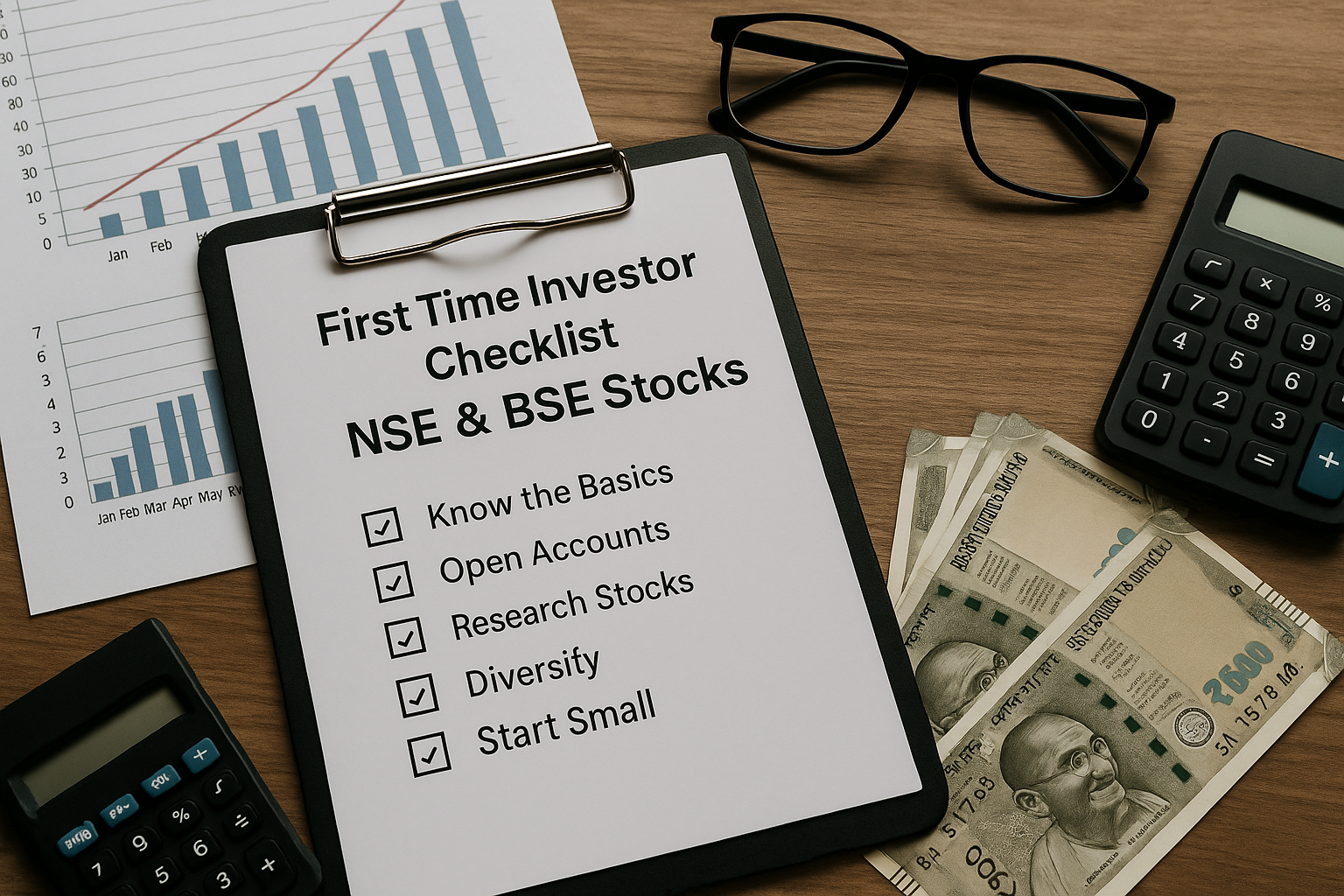
First Time Investor Checklist for NSE and BSE Stocks
Getting Started: NSE and BSE Basics
If you are an amateur in the Indian stock market, chances are that you have heard of NSE (National Stock Exchange) and BSE (Bombay Stock Exchange).
These are the two largest stock exchanges based on companies and transactions made per day.
- NSE also hosts a popular index called Nifty 50
- Sensex, one of the oldest market indices in Asia, is operated by BSE
Before you dive right in and buy that stock, it’s essential to understand the rules, tools and mindset required.
That’s where we come in with this first time investor checklist for NSE and BSE stocks — to get you started off on the right foot and investing safely.
1. Get to Know the Basics of the Stock Market
Now think well about it before investing either in NSE or BSE.
A share is a stake in the ownership of a company. If the company expands, the value of your share may increase and you might receive dividends as well.
Here’s what to know first:
- what is Dmat A/c And Trading A/c
- Difference between delivery trading and Intraday trading
- How market capitalization (large-cap, mid-cap, small-cap) works
- Deciphering dividends, IPOs and mutual funds
Once you understand these basics, you will have a grasp on how your investment really functions.
2. Step 1: Open a Trustworthy Demat as Well as Trading Account
You require two accounts in order to invest in stocks listed on NSE or BSE:
- Demat Account: Holds your shares in digital form
- Trading Account: Helps in the purchase and sale of shares
You can trade both with mainstream brokers, such as:
- Groww
- Zerodha (Kite)
- Upstox
- Angel One
Pro Tip:
✅ Pick a brokerage with low fees, good execution speed and helpful customer service.
✅ Ensure your PAN, Aadhaar and bank account are linked at the time of registration for KYC verification.
3. Identify Your Investment Goal
Before investing, define your why.
Ask yourself:
- Are you aiming to invest for long-term wealth, dividends or short-term gains?
- How much risk can you handle?
- How frequently will you check your portfolio?
For example:
If you are in for the long run (10+ years), you should invest on blue-chip stocks such as Infosys, HDFC or TCS.
You could consider mid-cap or sectoral stocks for short-term trading — though those are riskier.
Sooclix Tip:
Always invest according to long-term goals, not feelings.
4. Before You Invest in a Stock, Do Your Research
Never purchase a stock solely on someone else’s recommendation.
Use data — not gossip.
Here’s your mini research checklist:
- Look at the basics of the company: revenue, profit, debt, growth rate
- Understand its business model
- Quarterly reports and management discussion reads
- Check out P/E ratio, Return On Equity (ROE), EPS, and Debt-to-Equity ratio
- Research the company’s history and its future opportunities
Use tools like:
- Moneycontrol
- Tickertape
- Screener.in
These platforms allow you to analyse before investing your first rupee.
5. Diversify Your Portfolio
It’s not the smartest strategy to put all your money into a single stock — even if it’s in what you think is a “safe” company.
Diversify like this:
| Category | Allocation | Example Stocks |
|---|---|---|
| Large Cap | 50% | HDFC Bank, Infosys, TCS |
| Mid Cap | 30% | Deepak Nitrite, Tata Elxsi |
| Small Cap | 20% | Happiest Minds, IEX |
This diversity spreads risk while providing you opportunity for growth.
6. Start Small and Build Discipline
Start with anything from ₹1,000–₹5,000.
The first few investments you make aren’t about earning profits — they’re about learning.
Keep tracking your investments, making a note of any patterns and noting how prices respond to news or events.
At the start, it’s more about consistency than capital.
Instead, make investments with some regularity, even if they are small.
7. Stay Informed About the Market
Stay updated to invest in NSE and BSE stocks:
- Go through market news on Economic Times, Bloomberg, Moneycontrol etc
- Track latest market news, stock tips and expert advice on ETMarkets
- Follow company announcements, quarterly reports and government policy
Here at Sooclix Finance, we constantly remind potential investors —
“The market pays for patience and penalizes ignorance.
Knowledge is your strongest shield.”
8. Avoid Common Beginner Mistakes
Here are the mistakes new investors make, and how you can avoid them:
❌ Buying stocks without research
❌ Investing all money at once
❌ Pursuing “hot tips” or hot stocks
❌ Ignoring risk management
❌ Checking prices every hour
✅ Instead, learn to concentrate your investments and trust in growth over the long term.
9. Monitor and Manage Your Investments Periodically
Keep tracking and reviewing your portfolio in regular intervals.
And when you have invested, remember to watch.
Reassess your portfolio every 3 to 6 months.
Ask yourself:
- Are my goals on track?
- Are any stocks underperforming consistently?
- Should I rebalance my allocation?
Keep track of performance with the help of tools like Groww Portfolio or Tickertape Watchlist.
10. Learn, Adjust, and Keep Going
Stock investing is a marathon, not a sprint.
Even if your initial investment doesn’t pan out, figure out why.
Learn from what you did right or wrong and change your approach.
Stress also comes from the awkward fact that every great investor, from Warren Buffett to Rakesh Jhunjhunwala, made mistakes in their early years. You just have to be consistent and curious.
The Sooclix Finance Perspective
Empowering anyone who wants to join the new wave of internet investors via education and knowledge.
Your foray into NSE and BSE stocks doesn’t have to be daunting — it just needs to make sure that you are well-informed.
We demystify complicated market jargon for you, explain how to make money from investment, and aid you in making smart financial decisions.
👉 Begin investing in Sooclix Finance — where transparency meets growth.
Conclusion: Your Checklist Summary
Here is a checklist to follow before you buy your first stock on the NSE or BSE:
✅ Learn the basics
✅ Open Demat + Trading Account with trusted broker
✅ Define your goals
✅ Research before you invest
✅ Diversify wisely
✅ Start small, stay consistent
✅ Review your progress
You can start with a small investment, but the discipline you cultivate now will pave your way to financial freedom.